Unlocking MedTech Capital: A Guide to Securing $5M+ in Funding by Q3 2026 for US Startups

Anúncios
Unlocking MedTech Capital: A Strategic Guide to Securing $5M+ in Funding by Q3 2026 for US Startups
The United States MedTech landscape is a vibrant, innovation-driven ecosystem, yet securing substantial capital remains a formidable challenge for even the most promising startups. With a target of over $5 million in funding by Q3 2026, US MedTech startups face a complex journey requiring meticulous planning, strategic execution, and a deep understanding of investor expectations. This comprehensive guide will dissect the critical components necessary to navigate this intricate terrain, from refining your value proposition to mastering investor relations and regulatory compliance. Our focus is on empowering you to unlock significant MedTech funding in the competitive US market.
Anúncios
Anúncios
The MedTech sector, characterized by its high-stakes innovation and potential for transformative impact on patient care, attracts significant investment. However, the lengthy development cycles, stringent regulatory hurdles, and substantial capital requirements often deter generalist investors. Therefore, a targeted approach is paramount for any US MedTech startup aiming for robust funding rounds. This article delves into actionable strategies that will not only help you secure capital but also build a sustainable foundation for long-term success.
Understanding the MedTech Funding Landscape in the US
Before embarking on your fundraising journey, it’s crucial to grasp the nuances of the US MedTech funding environment. This involves recognizing key investor types, understanding their investment criteria, and identifying current market trends. The US market is unique due to its large patient population, advanced healthcare infrastructure, and a robust, albeit complex, regulatory framework.
Key Investor Types for MedTech Funding
- Venture Capital (VC) Firms: These are often the primary source of significant MedTech funding. VCs specializing in healthcare or life sciences are particularly valuable, as they bring not only capital but also industry expertise, networks, and strategic guidance. They typically look for disruptive technologies, strong intellectual property (IP), clear regulatory pathways, and substantial market potential.
- Corporate Venture Capital (CVC): Large pharmaceutical, medical device, or healthcare companies often have dedicated CVC arms. Investing in startups allows them to access innovation, expand their product pipelines, and potentially acquire promising technologies. CVCs can also offer valuable strategic partnerships, distribution channels, and clinical resources.
- Angel Investors & High-Net-Worth Individuals: While often providing earlier-stage capital, some angels specialize in MedTech and can contribute significant amounts. They might be former industry executives or successful entrepreneurs who offer mentorship alongside funding.
- Strategic Investors: These include foundations, family offices, and even some government-backed funds that have a specific interest in healthcare innovation. They often have longer investment horizons and can be more patient with the lengthy development cycles inherent in MedTech.
- Grant Funding & Non-Dilutive Capital: While not equity funding, grants from agencies like NIH (National Institutes of Health), BARDA (Biomedical Advanced Research and Development Authority), and other government programs can provide crucial non-dilutive capital to de-risk technology and advance development, making your startup more attractive to equity investors.
Current Market Trends and Investor Focus
Investors in US MedTech are increasingly drawn to innovations that address critical unmet medical needs, offer cost efficiencies, improve patient outcomes, and leverage digital health technologies. Key areas of interest include:
- Digital Health & AI: Solutions incorporating artificial intelligence, machine learning, telehealth, remote patient monitoring, and data analytics to enhance diagnostics, treatment, and patient management.
- Personalized Medicine: Technologies enabling tailored treatments based on individual patient characteristics, including genomics and advanced diagnostics.
- Minimally Invasive Devices: Devices that reduce recovery times, lower hospital stays, and improve surgical precision.
- Therapeutics & Diagnostics: Novel approaches to disease detection and treatment, especially in oncology, neurology, cardiovascular health, and rare diseases.
- Value-Based Care Solutions: Technologies that align with the shift towards value-based healthcare, demonstrating clear economic benefits and improved efficiency.
Understanding these trends will help you tailor your pitch and highlight how your innovation aligns with current investor priorities for MedTech funding.
Crafting Your Compelling Value Proposition and Business Plan
Your ability to articulate a clear, concise, and compelling value proposition is paramount. Investors are looking for solutions that solve significant problems in large markets. Your business plan must not only demonstrate this but also outline a credible path to commercialization and profitability.
Defining Your Unique Selling Proposition (USP)
- Identify the Unmet Need: Clearly define the medical problem you are solving. How significant is it? Who is affected? Provide data and statistics to back up your claims.
- Your Solution: Describe your technology or device in detail. What makes it innovative? How does it differentiate from existing solutions? Emphasize proprietary technology and IP.
- Patient & Economic Benefits: Quantify the impact. How does your solution improve patient outcomes, reduce costs, enhance efficiency, or provide a better user experience?
Developing a Robust Business Plan
Your business plan is your roadmap to success and a critical document for securing MedTech funding. It should be comprehensive yet digestible, covering:
- Executive Summary: A concise overview of your entire plan, highlighting your opportunity, solution, team, and financial projections.
- Company Description: Mission, vision, legal structure, and core values.
- Market Analysis: Detailed assessment of your target market size (TAM, SAM, SOM), growth potential, competitive landscape, and barriers to entry. Provide evidence of market validation.
- Product/Service Description: In-depth explanation of your technology, its features, benefits, development status, and intellectual property strategy.
- Regulatory Strategy: A clear roadmap for FDA approval (or other relevant regulatory bodies). This is a major de-risking factor for MedTech investors. Detail your pre-clinical and clinical trial plans.
- Commercialization Strategy: How will you bring your product to market? This includes sales and marketing plans, pricing strategy, distribution channels, and potential partnerships.
- Management Team: Highlight the experience, expertise, and track record of your key personnel. Investors invest in people as much as ideas. Address any gaps and how you plan to fill them.
- Financial Projections: Detailed 5-year financial forecasts including revenue, expenses, profit and loss statements, cash flow projections, and valuation. Be realistic and transparent about your assumptions.
- Funding Request & Use of Funds: Clearly state how much capital you are seeking and precisely how it will be utilized to achieve specific milestones.
Navigating Regulatory Pathways and Clinical Development
Regulatory approval and clinical validation are often the most significant hurdles and cost drivers in MedTech. A well-defined strategy in these areas is crucial for attracting MedTech funding.
FDA Regulatory Strategy
The US Food and Drug Administration (FDA) is the primary regulatory body for medical devices and diagnostics. Your strategy must address:
- Classification: Determine if your device is Class I, II, or III, as this dictates the regulatory pathway (e.g., 510(k), PMA, De Novo).
- Pre-Submission Meetings: Engage with the FDA early to clarify requirements and gain feedback on your development plan.
- Quality Management System (QMS): Implement a robust QMS (e.g., ISO 13485 compliance) from the outset.
- Clinical Evidence: Plan your clinical trials meticulously, demonstrating safety and efficacy. This often involves significant investment and time.
Clinical Development Plan
A well-structured clinical development plan is vital. It should outline:
- Study Design: Including endpoints, patient population, sample size, and statistical analysis.
- Investigator Selection: Choosing experienced clinical sites and investigators.
- Data Management & Monitoring: Ensuring data integrity and patient safety.
- Timeline & Budget: Realistic estimates for trial completion and associated costs.
Investors will scrutinize your regulatory and clinical plans. Demonstrating a clear, de-risked path forward significantly enhances your appeal for MedTech funding.
Building a Stellar Team and Advisory Board
Investors often say they invest in teams first, then technology. A strong, experienced team instills confidence that you can execute your vision and overcome challenges. For MedTech funding, this is especially true given the multi-disciplinary nature of the field.
Core Management Team
Your leadership team should ideally possess a blend of:
- Scientific/Technical Expertise: Founders and key R&D personnel with deep knowledge of the technology and its scientific basis.
- Clinical Expertise: Individuals with medical backgrounds, understanding patient needs, clinical workflows, and regulatory implications.
- Business Acumen: Experience in strategy, finance, operations, and market development within the healthcare sector.
- Regulatory & Quality Assurance Experience: Essential for navigating the complex FDA landscape.
Advisory Board
A well-curated advisory board can be a powerful asset, providing credibility, strategic guidance, and connections. Look for advisors with:
- Industry Leadership: Recognized experts in your specific therapeutic area or device category.
- Investment Experience: Individuals who understand the fundraising process and investor expectations.
- Regulatory & Clinical Trial Expertise: Former FDA officials or experienced clinical researchers.
- Strategic Partnerships: Individuals who can open doors to potential partners, customers, or key opinion leaders.
A robust team and advisory board not only enhance your operational capabilities but also significantly boost investor confidence, making your startup more attractive for MedTech funding.
Mastering Investor Relations and Pitching for MedTech Funding
Once your foundational elements are in place, the focus shifts to engaging with investors. This requires a strategic approach to identifying suitable partners, crafting a compelling pitch, and managing due diligence.
Identifying and Targeting the Right Investors
- Research: Identify VC firms, CVCs, and angel groups with a proven track record in MedTech investments, particularly in your specific sub-sector. Look at their portfolio companies and investment stages.
- Networking: Attend industry conferences, pitch events, and leverage your network (advisors, mentors, other founders) for warm introductions. Cold outreach is rarely effective.
- Tailor Your Approach: Understand each investor’s thesis and tailor your initial outreach and pitch deck to highlight how your company aligns with their investment strategy.
Crafting Your Pitch Deck
Your pitch deck is your primary tool for captivating investors. It should be visually appealing, concise (10-15 slides), and tell a compelling story. Key sections include:
- Problem: The unmet medical need.
- Solution: Your innovative technology.
- Market Opportunity: Size and growth potential.
- Technology & IP: What makes it defensible.
- Regulatory & Clinical Plan: Your path to approval and validation.
- Business Model: How you will generate revenue.
- Team: Why your team is uniquely qualified.
- Financial Projections: Realistic forecasts.
- Ask: How much MedTech funding you need and what milestones it will achieve.
The Art of the Pitch
Practice your pitch relentlessly. Be confident, enthusiastic, and able to answer tough questions. Focus on:
- Storytelling: Engage investors emotionally and intellectually.
- Clarity & Conciseness: Avoid jargon and get straight to the point.
- Highlighting Milestones: Emphasize what you’ve achieved and what the new funding will unlock.
- Addressing Risks: Be transparent about challenges and how you plan to mitigate them.
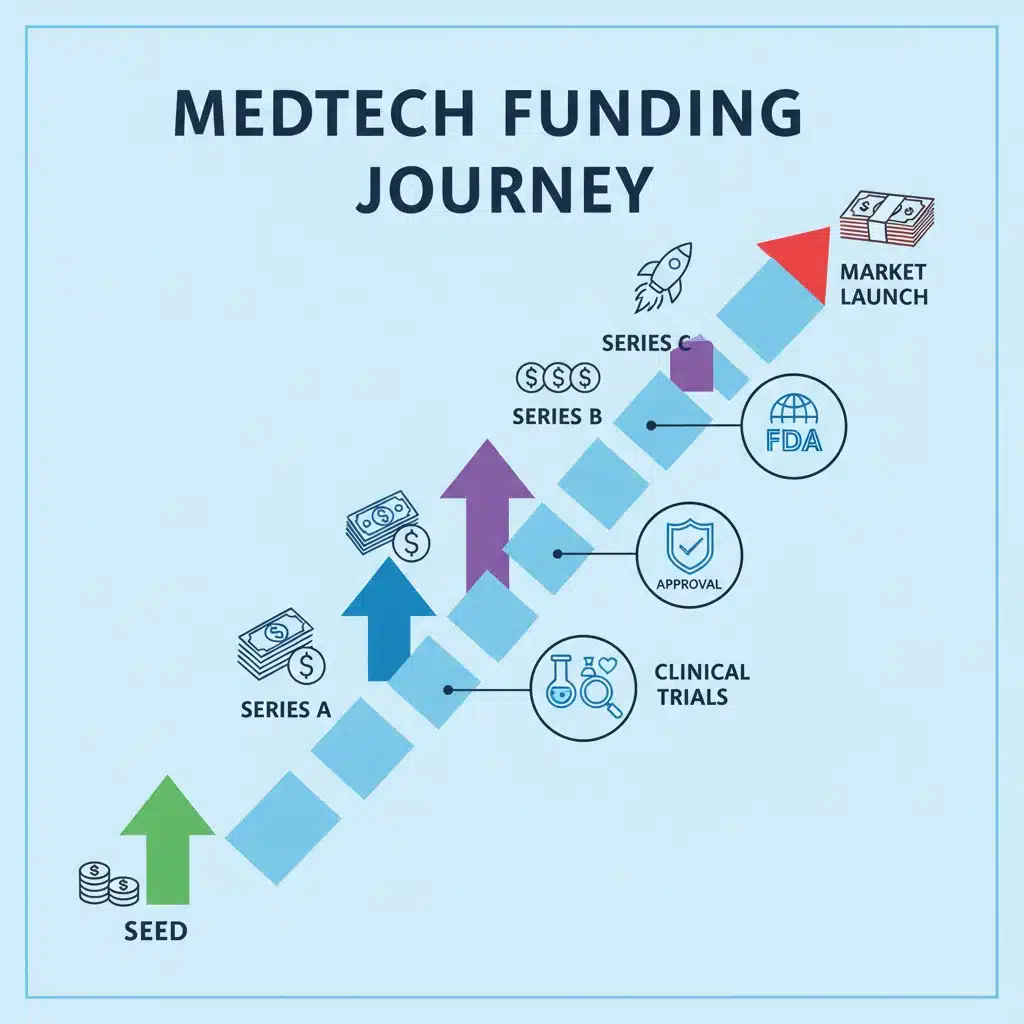
The Due Diligence Process
Once an investor expresses serious interest, you will enter the due diligence phase. This is an intensive review of every aspect of your company. Be prepared to provide:
- Legal Documents: Incorporation papers, cap table, IP filings, contracts.
- Financial Records: Historical financials, detailed projections, burn rate.
- Technical Data: R&D reports, preclinical study results, design specifications.
- Clinical Data: Clinical trial protocols, data, and reports.
- Regulatory Filings: FDA communications, pre-submissions, 510(k) or PMA documentation.
- Team Information: Resumes, background checks.
- Market Research: Validation studies, competitive analysis.
Having a well-organized data room (virtual or physical) with all necessary documents readily accessible will streamline this process and demonstrate your professionalism, significantly aiding in securing MedTech funding.
Valuation and Term Sheet Negotiation
Once due diligence is complete, if all goes well, you will receive a term sheet. This document outlines the proposed terms of the investment. Understanding valuation and key terms is crucial.
Understanding Valuation
Valuation in MedTech can be complex, often based on future potential, market size, IP strength, team experience, and stage of development. Common valuation methods include:
- Pre-money vs. Post-money Valuation: Understand the difference and its impact on your ownership.
- Comparable Company Analysis: Looking at recent funding rounds of similar MedTech companies.
- Discounted Cash Flow (DCF): Projecting future cash flows and discounting them back to present value (more common for later-stage companies).
Key Term Sheet Provisions
Be prepared to negotiate on various terms beyond just valuation. These can significantly impact your control and future fundraising efforts:
- Liquidation Preferences: How investors get paid back in an acquisition or liquidation event.
- Anti-dilution Provisions: Protecting investors from future down rounds.
- Board Representation: How many seats investors get on your board.
- Protective Provisions: Investor veto rights over certain company decisions.
- Vesting Schedules: For founders’ equity.
- Employee Option Pool: Setting aside shares for future hires.
It is highly recommended to engage experienced legal counsel specializing in venture capital and MedTech funding to review and negotiate term sheets. Their expertise can save you significant headaches and protect your interests in the long run.
Post-Funding Strategy: Growth and Milestones
Securing MedTech funding is not the end goal; it’s a new beginning. Your post-funding strategy should focus on efficient capital deployment, achieving milestones, and maintaining strong investor relations.
Efficient Capital Deployment
Every dollar raised should be strategically allocated to achieve the milestones outlined in your funding request. This includes:
- R&D and Product Development: Advancing your technology, conducting necessary testing, and iterating on designs.
- Clinical Trials: Funding patient recruitment, site management, and data analysis.
- Regulatory Submissions: Covering fees and expert consultations.
- Team Expansion: Hiring key personnel to scale operations.
- Market Entry & Commercialization: Initial marketing efforts, sales team development, and distribution partnerships.
Maintain strict financial discipline and regularly track your burn rate to ensure you have sufficient runway.
Achieving Key Milestones
Your investors will expect regular updates on your progress against the agreed-upon milestones. These could include:
- Successful completion of a preclinical study phase.
- FDA clearance/approval (e.g., 510(k) or PMA).
- Initiation or completion of a specific clinical trial phase.
- First-in-human use or patient enrollment targets.
- Attainment of specific sales or revenue targets post-commercialization.
- Key hires or strategic partnerships.
Achieving these milestones on time and within budget builds trust and positions you favorably for future funding rounds.
Maintaining Strong Investor Relations
Effective communication is vital. Provide regular, transparent updates to your investors, even when facing challenges. This includes:
- Quarterly Reports: Detailing financial performance, operational updates, and progress on milestones.
- Board Meetings: Regular, productive discussions with your board of directors (which will likely include investor representatives).
- Proactive Communication: Informing investors about significant developments (positive or negative) as they occur.
Strong investor relations can lead to follow-on investments and valuable introductions to other potential partners or customers, further enhancing your ability to secure MedTech funding.

Leveraging Strategic Partnerships
In the MedTech ecosystem, partnerships can accelerate development, de-risk your technology, and open new market opportunities. These can also make your startup more attractive to investors.
Types of Strategic Partnerships
- Academic Collaborations: Partnering with universities or research institutions for preclinical studies, clinical trials, or access to specialized equipment and expertise.
- Contract Research Organizations (CROs): Essential for managing clinical trials efficiently and compliantly.
- Contract Manufacturing Organizations (CMOs): For scaling production and ensuring quality control as you move towards commercialization.
- Large MedTech Companies: Collaborations could involve co-development agreements, licensing deals, or even early acquisition interest. These partnerships provide validation and access to vast resources.
- Healthcare Providers: Hospitals, clinics, and integrated delivery networks can serve as early adopters, pilot sites, and provide valuable feedback.
Demonstrating established or potential strategic partnerships in your business plan and investor pitches can significantly enhance your credibility and attractiveness for MedTech funding, as it shows a clear path to market and validation from industry players.
Conclusion: Your Path to $5M+ MedTech Funding by Q3 2026
Securing over $5 million in MedTech funding for a US startup by Q3 2026 is an ambitious but achievable goal. It demands a holistic strategy encompassing rigorous product development, meticulous regulatory planning, a compelling business case, and expert investor engagement. By focusing on a clear unmet need, building a stellar team, navigating the FDA effectively, and strategically approaching the right investors, you can significantly increase your chances of success.
Remember, fundraising is a marathon, not a sprint. It requires resilience, adaptability, and continuous refinement of your strategy. Every interaction, every data point, and every milestone achieved builds momentum. With a well-executed plan, a deep understanding of the US MedTech funding landscape, and unwavering determination, your innovative MedTech solution can attract the capital it needs to transform patient care and achieve significant market impact.
Start preparing now, refine your pitch, and build those crucial relationships. The MedTech funding ecosystem in the US is ripe with opportunity for those who are truly ready to seize it.
Author