
The MedTech sector stands at the precipice of unprecedented growth, driven by an aging global population, increasing prevalence of chronic diseases, and rapid technological advancements. For investors, identifying and evaluating promising MedTech investment opportunities requires a sophisticated understanding of not only current market dynamics but also robust future financial projections. This article delves into a comprehensive 3-year financial projection framework specifically designed for MedTech investment opportunities, offering insights into how to navigate the complexities of this dynamic industry and position your portfolio for success from 2026 and beyond. Understanding MedTech Investment Projections is crucial for strategic decision-making.
Anúncios
Anúncios
The healthcare landscape is undergoing a profound transformation, with medical technology playing a pivotal role. From AI-powered diagnostics to robotic surgery and personalized medicine, innovation is constantly reshaping patient care and creating lucrative avenues for investment. However, the unique characteristics of the MedTech sector—long development cycles, stringent regulatory hurdles, and complex market access strategies—demand a specialized approach to financial forecasting. Without a clear framework for MedTech Investment Projections, investors risk misjudging potential returns and overlooking critical risks.
The Evolving MedTech Landscape: A Foundation for Projections
Before diving into financial models, it’s imperative to grasp the macro trends shaping the MedTech sector. These trends form the bedrock upon which accurate MedTech Investment Projections are built. Key drivers include:
- Demographic Shifts: An aging global population and rising life expectancies translate to increased demand for medical devices, diagnostics, and innovative treatments for age-related conditions.
- Technological Convergence: The fusion of MedTech with artificial intelligence, machine learning, big data, and IoT is creating entirely new product categories and enhancing existing ones, leading to predictive analytics, personalized therapies, and remote patient monitoring.
- Digital Health Integration: The growing adoption of digital health solutions, including telehealth, wearable devices, and health apps, is expanding the reach of MedTech and generating vast amounts of health data.
- Precision Medicine: Advances in genomics and diagnostics are paving the way for highly personalized treatments, requiring specialized devices and diagnostic tools.
- Emerging Markets: Growing healthcare expenditures and improving infrastructure in developing economies present significant opportunities for market expansion.
- Regulatory Evolution: Regulatory bodies worldwide are adapting to new technologies, which can create both opportunities (faster approvals for breakthrough devices) and challenges (increased scrutiny, new compliance requirements).
Each of these factors must be considered when attempting to create robust MedTech Investment Projections. A thorough understanding of these underlying forces allows investors to identify companies that are well-positioned to capitalize on future growth and mitigate potential disruptions.
Pillars of a 3-Year Financial Projection Framework for MedTech
A successful 3-year financial projection framework for MedTech investment opportunities must be comprehensive, adaptable, and forward-looking. It should integrate quantitative financial modeling with qualitative market and regulatory insights. Here are the key pillars:
1. Revenue Forecasting: Beyond Simple Growth
Revenue forecasting in MedTech is more nuanced than in many other sectors. It involves understanding product lifecycles, market penetration rates, competitive landscapes, and reimbursement policies. For MedTech Investment Projections, consider:
- Product Pipeline Analysis: Assess the stage of development for new products (pre-clinical, clinical trials, regulatory submission, market launch). Assign probabilities of success and estimate time to market.
- Market Size and Segmentation: Define the total addressable market (TAM) for each product, segment it by geography, patient population, and clinical indication. Project market growth rates based on demographic trends, disease prevalence, and technological adoption.
- Market Share Assumptions: Evaluate the competitive landscape, including existing players, potential new entrants, and substitutes. Base market share projections on product differentiation, clinical efficacy, pricing strategy, sales force strength, and marketing efforts.
- Pricing and Reimbursement: Understand the pricing strategies (premium, competitive, value-based) and the reimbursement environment. Changes in insurance coverage or government healthcare policies can significantly impact revenue.
- Sales Volume Projections: Combine market share, pricing, and market size to forecast unit sales and subsequent revenue. Consider seasonality, product upgrades, and potential obsolescence.
A detailed breakdown of revenue streams for each product and geography will yield more accurate MedTech Investment Projections. Don’t simply apply an industry average growth rate; delve into the specifics of the company’s offerings and market position.
2. Cost of Goods Sold (COGS) and Operating Expenses (OpEx)
Forecasting COGS and OpEx is critical for determining profitability. In MedTech, these can be heavily influenced by several factors:
- COGS: Includes direct materials, labor, and manufacturing overhead. Consider economies of scale as production volumes increase, supply chain efficiencies, and potential for automation. For complex devices, intellectual property licensing fees can also be a significant COGS component.
- Research and Development (R&D): A cornerstone of MedTech. Project R&D spend based on the company’s innovation strategy, pipeline intensity, and clinical trial costs. R&D can be lumpy and unpredictable, so scenario analysis is crucial for accurate MedTech Investment Projections.
- Sales, General, and Administrative (SG&A): This includes marketing, sales force expansion, administrative overhead, and legal expenses. As companies scale, SG&A often increases, particularly in sales-driven organizations. Account for geographic expansion and new product launches.
- Clinical Trial Expenses: These are often substantial and can vary widely based on trial design, patient recruitment, and duration. Factor in potential delays or unexpected costs.
- Regulatory Compliance Costs: The cost of obtaining and maintaining regulatory approvals (e.g., FDA, CE Mark) can be significant and ongoing.
Accurate forecasting of these expenses is vital for assessing the company’s operational efficiency and its path to profitability within the MedTech Investment Projections timeframe.
3. Capital Expenditures (CapEx) and Working Capital
MedTech companies, especially those involved in manufacturing, often have significant CapEx requirements. Working capital management is also crucial for liquidity.
- Capital Expenditures: Project investments in property, plant, and equipment (PP&E), including manufacturing facilities, specialized machinery, and R&D infrastructure. These are often tied to scaling production or developing new technologies.
- Working Capital: Analyze trends in accounts receivable, inventory, and accounts payable. MedTech companies can have long sales cycles and inventory holding periods, impacting cash flow. Efficient working capital management is a strong indicator of operational health and directly influences MedTech Investment Projections regarding cash flow.
Understanding these capital requirements provides a clearer picture of the company’s funding needs and its ability to generate free cash flow.
Advanced Considerations for Robust MedTech Investment Projections
Beyond the core financial statements, several advanced considerations are essential for truly robust MedTech Investment Projections.
Regulatory Pathway and Risk Assessment
The regulatory environment is arguably the most critical and often underestimated aspect of MedTech investment. A company’s ability to navigate regulatory hurdles directly impacts its time to market, commercial success, and overall financial viability. 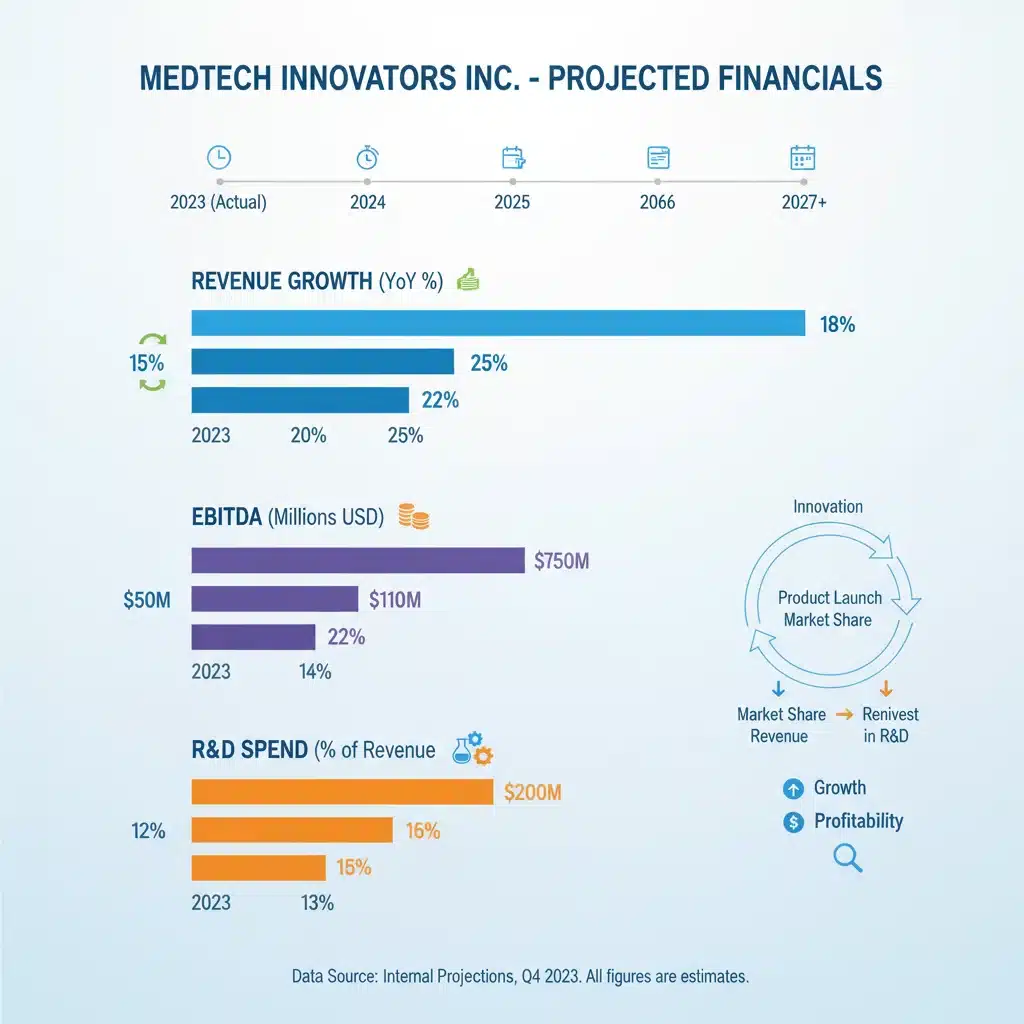
- Regulatory Strategy: Evaluate the company’s strategy for gaining approvals (e.g., FDA 510(k), PMA, De Novo, CE Mark). Understand the classification of their devices and the associated requirements.
- Clinical Evidence: Assess the strength of clinical data supporting product claims. Weak clinical evidence can lead to delays or rejection.
- Post-Market Surveillance: Factor in ongoing compliance costs and the potential for recalls or adverse event reporting.
- International Regulations: If the company has global aspirations, understand the complexities of regulations in different key markets (e.g., EU MDR, China NMPA).
Incorporating regulatory risk into scenario analysis is paramount for accurate MedTech Investment Projections. Delays in approval can significantly impact revenue timelines and burn rates.
Intellectual Property (IP) Portfolio
A strong IP portfolio is a competitive moat in MedTech. Evaluate the breadth and depth of patents, trademarks, and trade secrets. Assess the remaining patent life for key products and the potential for new IP generation. Litigation risk related to IP infringement should also be considered in MedTech Investment Projections.
Reimbursement Landscape
Even with regulatory approval, a device won’t succeed without adequate reimbursement. This involves understanding payer policies, coding, and coverage decisions. Evaluate:
- Coding and Coverage: Is there an existing CPT code for the procedure or device? If not, what is the pathway to obtaining one, and how long will it take?
- Payer Adoption: What is the likelihood that private and public payers will cover the device? What evidence is required to demonstrate cost-effectiveness and clinical utility?
- Value-Based Care Models: How does the device fit into evolving value-based care models, where outcomes rather than volume are reimbursed?
The reimbursement environment can make or break a MedTech product, and its impact on future revenue must be carefully integrated into MedTech Investment Projections.
Technological Obsolescence and Innovation Cycles
The MedTech sector is characterized by rapid innovation. What is cutting-edge today may be obsolete tomorrow. Consider:
- Competitive Disruption: What are competitors developing? Are there emerging technologies that could render the target company’s products less competitive?
- Internal Innovation: Does the company have a robust R&D pipeline to stay ahead of the curve?
- Upgrade Cycles: For certain devices, understand the typical upgrade cycle for hospitals and clinics.
Factoring in the pace of innovation helps to temper overly optimistic MedTech Investment Projections and introduces a dose of realism.
Building the Financial Model: Tools and Techniques
With the pillars and advanced considerations in mind, the next step is to build the actual financial model. This typically involves:
- Three-Statement Model: Projecting the Income Statement, Balance Sheet, and Cash Flow Statement for the next three years. This provides a holistic view of the company’s financial health.
- Driver-Based Modeling: Instead of simply projecting growth rates, link financial line items to operational drivers (e.g., number of units sold, average selling price, R&D projects, headcount). This makes the model more robust and easier to sensitize.
- Scenario Analysis: Develop multiple scenarios (base case, optimistic, pessimistic) to account for uncertainties in regulatory approvals, market adoption, and competitive pressures. This is particularly important for MedTech Investment Projections due to inherent industry risks.
- Sensitivity Analysis: Identify key variables (e.g., market share, pricing, clinical trial success rates) and analyze how changes in these variables impact the projected outcomes.
- Discounted Cash Flow (DCF) Analysis: Use the projected free cash flows to calculate an intrinsic valuation of the company.
- Comparable Company Analysis (CCA) and Precedent Transactions: Benchmark the target company against similar publicly traded companies and recent M&A deals to derive valuation multiples.
The goal is not just to generate numbers but to understand the underlying assumptions and their impact on the financial outlook. A flexible model allows for quick adjustments as new information becomes available, refining your MedTech Investment Projections.
Mitigating Risks and Maximizing Returns in MedTech Investment
Investing in MedTech, while potentially highly rewarding, comes with inherent risks. A robust financial projection framework helps identify and mitigate these risks:
- Regulatory Risk: Delays or rejections from regulatory bodies. Mitigation: Thorough due diligence on regulatory strategy, strong clinical data, and experienced regulatory affairs teams.
- Commercialization Risk: Failure to achieve expected market adoption or reimbursement. Mitigation: Deep market understanding, strong sales and marketing strategy, and clear reimbursement pathways.
- Technological Risk: Product failure, unexpected side effects, or rapid obsolescence. Mitigation: Robust R&D, strong IP protection, and diversified product pipeline.
- Financial Risk: Insufficient funding, cash flow issues, or inability to achieve profitability. Mitigation: Realistic financial projections, strong balance sheet, and access to capital.
- Competitive Risk: New entrants or superior products from competitors. Mitigation: Continuous innovation, strong IP, and strategic partnerships.
By systematically addressing these risks within your MedTech Investment Projections, you can refine your investment thesis and identify companies with a higher probability of long-term success.
The Future of MedTech Investment: Beyond 2026
Looking beyond the 3-year projection horizon, the MedTech sector is poised for continued transformation. Key trends that will shape investment opportunities include:
- Personalized and Predictive Healthcare: Further integration of AI, genomics, and real-time data to offer highly individualized diagnostics and treatments.
- Decentralized Care: A shift from hospital-centric care to home-based and community-based care, driven by remote monitoring, telehealth, and portable diagnostic devices.
- Surgical Robotics and Automation: Continued advancements in robotic-assisted surgery, enhancing precision, reducing invasiveness, and improving patient outcomes.
- Advanced Materials and Bio-Integration: Development of novel biomaterials, smart implants, and regenerative medicine solutions that seamlessly integrate with the human body.
- Cybersecurity in Medical Devices: As devices become more connected, cybersecurity will be a critical factor for both patient safety and regulatory compliance.
Investors who integrate these long-term trends into their strategic thinking will be better equipped to identify the next generation of MedTech leaders. While our framework focuses on 3-year MedTech Investment Projections, understanding the secular shifts provides context for sustained growth.
Conclusion: Mastering MedTech Investment Projections for Future Success
Evaluating MedTech investment opportunities requires more than just a glance at historical financials. It demands a forward-looking, comprehensive framework that accounts for the industry’s unique dynamics. By meticulously developing 3-year financial projections that consider revenue drivers, cost structures, capital needs, and critical qualitative factors like regulatory pathways, IP, and reimbursement, investors can make more informed decisions.
The MedTech sector offers immense potential for growth and innovation. However, success hinges on a disciplined approach to analysis, anchored in robust MedTech Investment Projections. As we move into 2026 and beyond, those who master this framework will be best positioned to capitalize on the transformative power of medical technology, driving both financial returns and meaningful advancements in global healthcare.
Remember, the accuracy of your projections is directly proportional to the depth of your research and the realism of your assumptions. Continuously update your models with new market data, regulatory changes, and company performance to maintain a dynamic and reliable view of your MedTech investments.