
Achieving Healthcare Interoperability US 2026: A Comprehensive Guide
The landscape of United States healthcare is undergoing a profound transformation, driven by an urgent need for seamless information exchange. As we edge closer to 2026, the imperative for robust Healthcare Interoperability US 2026 becomes not just a technological aspiration but a fundamental requirement for delivering high-quality, patient-centered care. This comprehensive guide delves into the intricacies of achieving true interoperability, exploring the regulatory mandates, technological advancements, and strategic imperatives that will shape the future of healthcare data exchange.
Anúncios
Anúncios
The Genesis of a Mandate: Why Healthcare Interoperability US 2026 Matters
For decades, the US healthcare system has grappled with fragmented data, often trapped in disparate systems and silos. This fragmentation has led to inefficiencies, medical errors, redundant tests, and an incomplete picture of a patient’s health journey. The vision for Healthcare Interoperability US 2026 is to dismantle these barriers, enabling a free and secure flow of health information across providers, payers, and patients.
Historical Context and Evolving Regulations
The journey towards interoperability gained significant momentum with the HITECH Act of 2009, which incentivized the adoption of Electronic Health Records (EHRs). While EHR adoption soared, true interoperability remained elusive. Early EHR systems were often proprietary, lacking standardized ways to communicate with external systems. The 21st Century Cures Act, passed in 2016, marked a pivotal shift, explicitly mandating interoperability and prohibiting information blocking. This legislation laid the groundwork for the regulations we see influencing Healthcare Interoperability US 2026 today.
Key Drivers for 2026
Several factors are accelerating the push for Healthcare Interoperability US 2026:
- Improved Patient Outcomes: Access to a complete patient history allows clinicians to make more informed decisions, leading to better diagnoses, personalized treatment plans, and reduced adverse events.
- Enhanced Patient Engagement: Patients empowered with their health data can actively participate in their care, leading to greater satisfaction and adherence to treatment.
- Reduced Healthcare Costs: Avoiding duplicate tests, streamlining administrative processes, and improving care coordination can significantly lower overall healthcare expenditures.
- Public Health Initiatives: During public health crises, rapid and accurate data exchange is crucial for surveillance, response, and resource allocation.
- Value-Based Care Models: The shift from fee-for-service to value-based care necessitates comprehensive data sharing to measure outcomes and demonstrate quality.
Understanding the Core Components of Healthcare Interoperability US 2026
Achieving interoperability is not a monolithic task; it involves several interconnected components working in harmony. For Healthcare Interoperability US 2026, these components are critical:
1. Standardized Data Formats and APIs
The bedrock of interoperability lies in common data standards. Without a universal language, systems cannot communicate effectively. The Fast Healthcare Interoperability Resources (FHIR – pronounced ‘fire’) standard has emerged as the leading solution. FHIR, developed by HL7, provides a flexible, internet-friendly standard for exchanging healthcare information. Its use of modern web technologies, like RESTful APIs, makes it highly adaptable for various applications, from mobile health apps to complex EHR integrations.
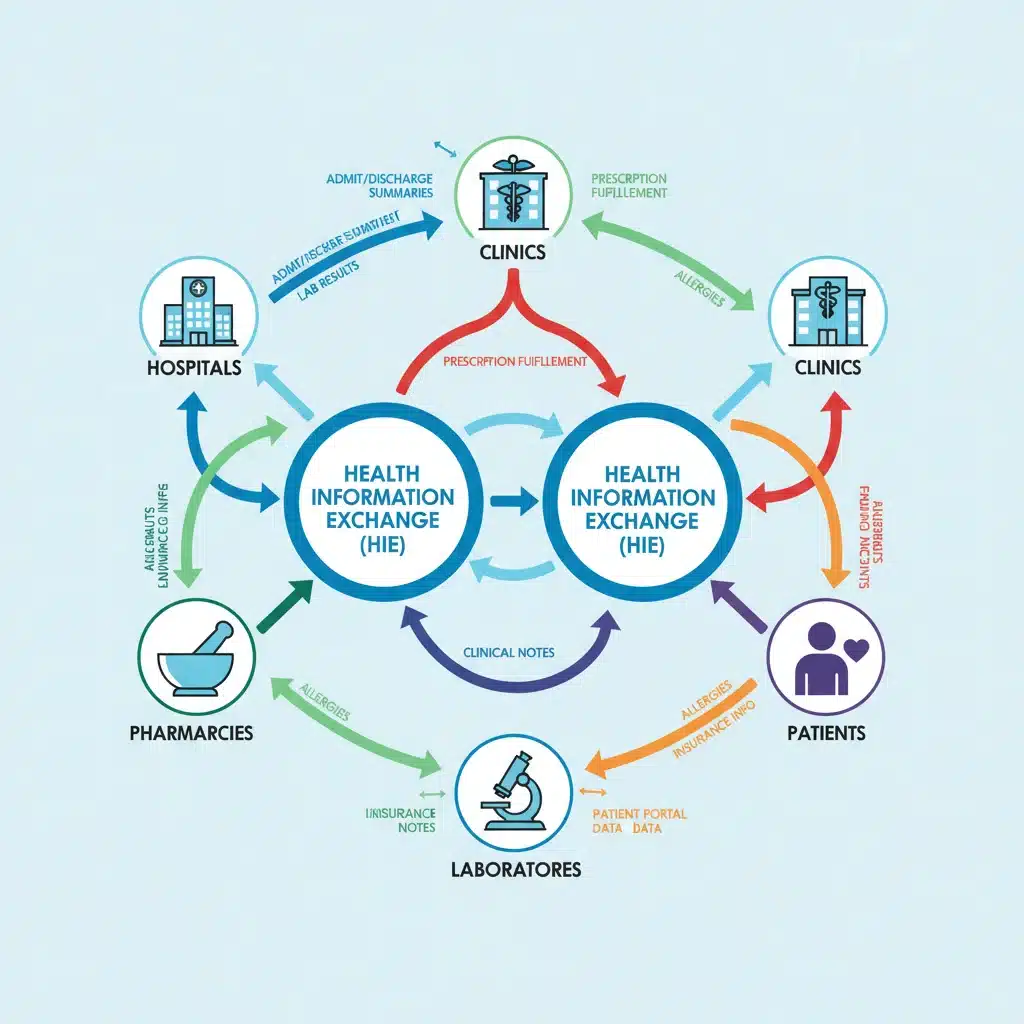
2. Health Information Exchanges (HIEs)
HIEs are critical infrastructure that facilitates the secure exchange of health information among different healthcare stakeholders. They act as a central hub, connecting diverse systems and enabling providers to access patient data from various sources. Effective HIEs are vital for achieving widespread Healthcare Interoperability US 2026, ensuring that data follows the patient wherever they receive care.
3. Identity Management and Patient Matching
Accurately identifying and matching patient records across different systems is a persistent challenge. Discrepancies in patient identifiers can lead to duplicate records, incorrect data associations, and compromised patient safety. Advanced patient matching algorithms, often leveraging artificial intelligence and machine learning, are essential to ensure that the right data is linked to the right patient, a cornerstone of Healthcare Interoperability US 2026.
4. Security and Privacy
The exchange of sensitive health information necessitates robust security and privacy safeguards. Compliance with HIPAA regulations is non-negotiable, but interoperability demands even more advanced measures. Encryption, access controls, audit trails, and secure authentication protocols are paramount to protect patient data from breaches and unauthorized access. Building trust in the interoperable ecosystem is crucial for its adoption and success by 2026.
Regulatory Frameworks and Mandates Driving Healthcare Interoperability US 2026
The journey to Healthcare Interoperability US 2026 is heavily influenced by a series of regulations and mandates designed to push the industry forward.
The 21st Century Cures Act and ONC Final Rule
The Office of the National Coordinator for Health Information Technology (ONC) Final Rule, a direct outcome of the 21st Century Cures Act, is perhaps the most impactful regulation. It mandates:
- Information Blocking Prohibition: This rule makes it illegal for healthcare providers, health IT developers, and HIEs to knowingly and unreasonably interfere with the access, exchange, or use of electronic health information (EHI). This is a game-changer for Healthcare Interoperability US 2026.
- Patient Access APIs: Health plans must implement and maintain secure, standards-based APIs to allow patients to easily access their claims and clinical information.
- Provider Directory APIs: Health plans must make provider directory information publicly available via an API, facilitating easier access to care.
- Public Health Information (PHI) Access: Encourages the use of standardized APIs to support public health reporting and surveillance.
CMS Interoperability and Patient Access Rule
The Centers for Medicare & Medicaid Services (CMS) also issued a complementary rule focusing on patient access and data exchange within its programs. Key aspects include:
- Patient Access API: Similar to the ONC rule, this mandates health plans to provide patients with access to their data through APIs.
- Provider Directory API: Requires health plans to make provider directory information available via an API.
- Payer-to-Payer Data Exchange: Mandates that payers exchange certain patient clinical data with other payers when a patient moves between plans, ensuring continuity of care. This is a significant step towards comprehensive Healthcare Interoperability US 2026.

Technological Advancements Paving the Way for Healthcare Interoperability US 2026
Beyond regulations, technological innovation is the engine driving the realization of Healthcare Interoperability US 2026. Several key technologies are at the forefront:
FHIR APIs and Ecosystems
As mentioned, FHIR is central. Its adoption has spurred the development of an extensive ecosystem of applications and services built on these APIs. This includes:
- EHR Vendor Adaptations: Major EHR vendors are rapidly integrating FHIR APIs into their platforms, making it easier for third-party applications to connect and exchange data.
- Third-Party Application Development: A new wave of health apps, patient portals, and care coordination tools are leveraging FHIR to access and present patient data in innovative ways.
- Data Aggregation Platforms: Solutions that pull data from multiple sources via FHIR APIs, normalize it, and present a unified view often using AI for insights.
Artificial Intelligence and Machine Learning
AI and ML are playing an increasingly vital role in overcoming interoperability challenges:
- Patient Matching: AI algorithms can analyze vast datasets to accurately match patient records even with incomplete or inconsistent information.
- Natural Language Processing (NLP): NLP can extract structured data from unstructured clinical notes, making previously inaccessible information available for exchange and analysis.
- Data Normalization and Mapping: AI can help normalize data from different formats and map it to standardized terminologies, reducing the manual effort required for integration.
- Predictive Analytics: With integrated data, AI can power predictive models for disease outbreaks, patient deterioration, and treatment efficacy, enhancing proactive care.
Cloud Computing
The scalability, flexibility, and security offered by cloud platforms are instrumental for Healthcare Interoperability US 2026. Cloud-based HIEs, data warehouses, and application hosting enable healthcare organizations to store, process, and exchange vast amounts of data efficiently and securely, without the need for extensive on-premise infrastructure.
Blockchain Technology (Emerging)
While still in its nascent stages for healthcare, blockchain holds promise for enhancing data security, provenance, and patient consent management in an interoperable environment. Its decentralized and immutable ledger could provide a highly secure and auditable record of data transactions, further strengthening trust in the system as Healthcare Interoperability US 2026 evolves.
Challenges and Roadblocks on the Path to Healthcare Interoperability US 2026
Despite the significant progress, achieving full Healthcare Interoperability US 2026 is not without its hurdles.
Legacy Systems and Technical Debt
Many healthcare organizations still rely on outdated legacy systems that are difficult to integrate with modern technologies. The cost and complexity of replacing or upgrading these systems represent a significant barrier. This technical debt can slow down the adoption of new interoperability standards like FHIR.
Data Governance and Semantics
Even with standardized formats, semantic interoperability remains a challenge. Different organizations may use the same terms to mean different things, or different terms to mean the same thing. Establishing consistent data governance policies and mapping clinical concepts to standardized terminologies (e.g., SNOMED CT, LOINC) is crucial but complex.
Cost Implications
Implementing interoperability solutions requires substantial investment in technology, infrastructure, training, and personnel. Smaller practices and rural hospitals may struggle to bear these costs, potentially widening the digital divide in healthcare access.
Privacy Concerns and Trust
While regulations aim to protect patient data, public and organizational anxiety about data sharing persists. Building trust through transparent data governance, robust security measures, and clear patient consent mechanisms is essential for widespread adoption of Healthcare Interoperability US 2026.
Information Blocking Persistence
Despite the prohibition, information blocking can still occur subtly, through contractual agreements, high fees for data access, or deliberately complex technical hurdles. Continuous monitoring and enforcement by regulatory bodies are necessary to combat these practices.
Strategies for Success: Navigating Healthcare Interoperability US 2026
To successfully navigate the complexities and achieve the vision of Healthcare Interoperability US 2026, organizations must adopt proactive and strategic approaches.
1. Embrace FHIR First
Prioritize the adoption and implementation of FHIR-based APIs. Engage with EHR vendors to ensure their platforms support the latest FHIR versions and actively participate in FHIR accelerators and implementation guides. This will be foundational for any future interoperability efforts.
2. Invest in Data Governance and Quality
Establish robust data governance frameworks that define data ownership, quality standards, and access policies. Invest in master data management (MDM) solutions for patient identification and data normalization. Clean, standardized data is the fuel for effective interoperability.
3. Strengthen Security and Privacy Posture
Beyond HIPAA compliance, implement advanced cybersecurity measures. Conduct regular security audits, provide comprehensive staff training on data privacy, and explore emerging technologies like homomorphic encryption or secure multi-party computation for highly sensitive data exchanges.
4. Foster Collaboration and Partnerships
Interoperability is a shared responsibility. Engage with HIEs, participate in industry consortia, and collaborate with other healthcare organizations, payers, and technology vendors. Collective action is far more effective than isolated efforts.
5. Leverage Cloud and AI/ML Technologies
Migrate to cloud-based platforms for scalability and flexibility. Explore how AI and ML can automate data processing, enhance patient matching, and derive actionable insights from integrated data. These technologies are powerful enablers for Healthcare Interoperability US 2026.
6. Prioritize Patient Engagement Tools
Develop and promote user-friendly patient portals and mobile applications that leverage interoperable data. Empowering patients with access to their health information not only meets regulatory requirements but also improves health literacy and outcomes.
7. Continuous Education and Training
The interoperability landscape is constantly evolving. Ensure that staff, from clinicians to IT professionals, receive ongoing education and training on new standards, technologies, and best practices. A well-informed workforce is crucial for successful implementation of Healthcare Interoperability US 2026 initiatives.
The Future of Healthcare Interoperability US 2026 and Beyond
The year 2026 marks a significant milestone, but it is not the end of the journey. It is a critical stepping stone towards a truly connected healthcare ecosystem. Looking beyond 2026, we can anticipate:
- Greater Semantic Interoperability: Moving beyond just data exchange to genuine understanding and interpretation of data across diverse systems.
- Personalized Medicine at Scale: Interoperable data will fuel precision medicine initiatives, allowing for highly individualized treatment plans based on a comprehensive view of a patient’s genetic, lifestyle, and clinical data.
- Proactive and Preventive Care: With real-time data access and AI-driven insights, healthcare will shift further towards proactive interventions and preventive strategies, reducing the burden of chronic diseases.
- Enhanced Public Health Surveillance: The ability to aggregate and analyze population health data seamlessly will significantly strengthen our capacity to respond to epidemics and improve overall public health.
- Seamless Integration of Social Determinants of Health (SDOH): Interoperability will extend beyond traditional clinical data to include social, economic, and environmental factors that impact health, leading to more holistic care.
Conclusion: Building a Connected Health Future
The push for Healthcare Interoperability US 2026 represents a monumental effort to modernize the US healthcare system. While the challenges are substantial, the benefits—improved patient safety, enhanced care quality, reduced costs, and a more engaged patient population—are too compelling to ignore. By embracing standardized technologies like FHIR, leveraging the power of AI and cloud computing, adhering to robust regulatory frameworks, and fostering a spirit of collaboration, healthcare organizations can effectively dismantle data silos and build a truly connected health future. The journey to Healthcare Interoperability US 2026 is not just about compliance; it’s about transforming healthcare delivery for generations to come, creating a system where information flows freely and securely, always serving the best interests of the patient.