Mastering AI Ethics in Clinical Practice: A 3-Month U.S. Learning Plan

Anúncios
The rapid advancement of Artificial Intelligence (AI) in healthcare presents unprecedented opportunities to enhance diagnostics, personalize treatments, and optimize patient care. However, with these innovations come profound ethical challenges that demand careful consideration and proactive integration into clinical practice. In the United States, the unique regulatory landscape, diverse patient populations, and complex healthcare system amplify the need for a robust understanding of AI Ethics Clinical Practice. This article outlines a comprehensive, practical 3-month learning plan designed to equip healthcare professionals with the knowledge and tools necessary to navigate the ethical dimensions of AI in their daily clinical work.
Anúncios
Anúncios
Mastering AI Ethics in Clinical Practice: A 3-Month U.S. Learning Plan
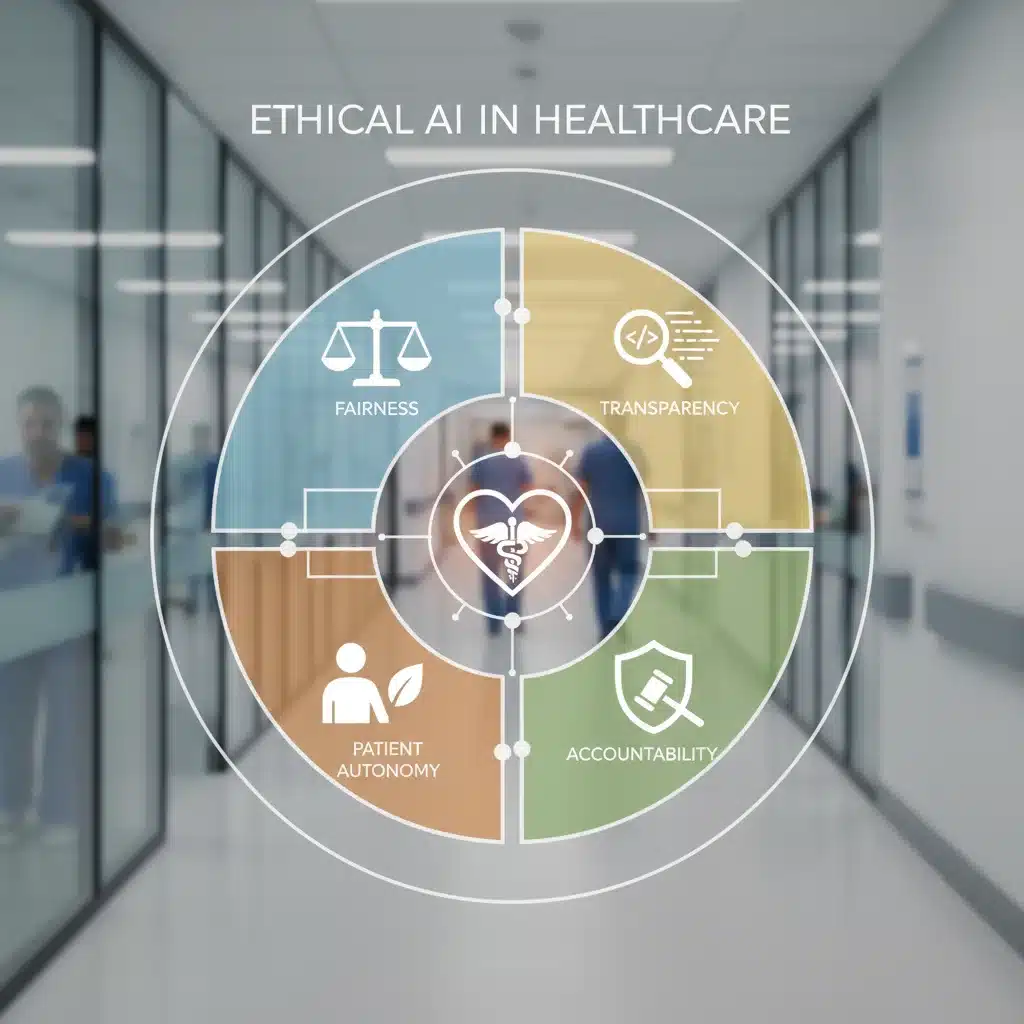
As AI technologies become increasingly embedded in every facet of medicine, from predictive analytics to robotic surgery, the ethical implications are no longer theoretical debates but pressing practical concerns. Ensuring fairness, transparency, accountability, and patient autonomy in AI-driven healthcare is paramount. This learning plan focuses specifically on the U.S. context, addressing its regulatory frameworks, cultural nuances, and specific challenges. By the end of this intensive three-month journey, participants will possess a foundational understanding of AI ethics, practical strategies for ethical AI implementation, and the ability to critically evaluate AI tools in their clinical settings, fostering responsible AI Ethics Clinical Practice.
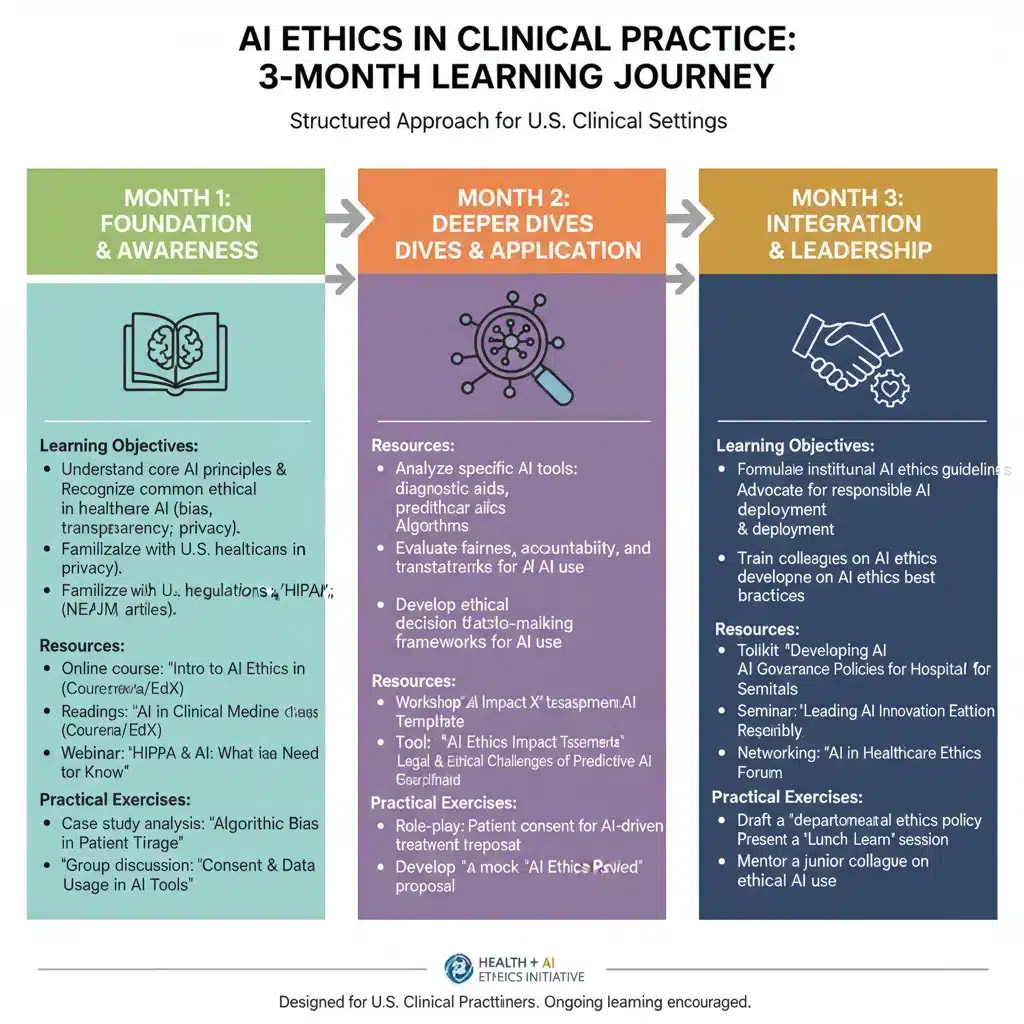
Month 1: Foundations of AI Ethics and U.S. Regulatory Landscape
The first month is dedicated to building a solid theoretical and regulatory foundation. Understanding the core principles of AI ethics and the specific legal and policy environment in the U.S. is crucial for any healthcare professional looking to integrate AI responsibly. This phase emphasizes self-directed learning, engaging with seminal texts, and familiarizing oneself with key organizations and their guidelines.
Week 1: Introduction to AI and Core Ethical Principles in Healthcare
The journey begins with a fundamental understanding of what AI is, how it functions in healthcare, and the ethical considerations it introduces. This week lays the groundwork for all subsequent learning.
- Learning Objectives:
- Define Artificial Intelligence, Machine Learning, and Deep Learning in the context of healthcare.
- Identify common applications of AI in clinical practice (e.g., diagnostics, drug discovery, personalized medicine).
- Understand foundational ethical principles relevant to healthcare (beneficence, non-maleficence, autonomy, justice).
- Introduce ethical challenges posed by AI in healthcare (e.g., bias, privacy, accountability, transparency).
- Recommended Resources:
- Readings: Selected chapters from textbooks on AI in healthcare and medical ethics. Articles from JAMA, NEJM, or The Lancet focusing on AI’s ethical implications.
- Online Courses: Introductory modules on AI in healthcare from platforms like Coursera (e.g., Google AI for Healthcare, Stanford’s AI in Medicine).
- Videos: TED Talks or university lectures on AI ethics.
- Practical Exercise:
- Case Study Analysis: Select a high-profile case where AI in healthcare has raised ethical questions. Analyze the case using the four core ethical principles.
- Journaling: Reflect on personal biases and how they might unintentionally influence the interpretation or application of AI in clinical settings.
Week 2: Bias, Fairness, and Equity in AI
One of the most critical ethical concerns in AI is the potential for bias to perpetuate or even exacerbate existing health disparities. This week delves into the sources of bias and strategies for promoting fairness and equity.
- Learning Objectives:
- Identify sources of bias in AI algorithms (data bias, algorithmic bias, human bias).
- Understand the impact of biased AI on health equity and vulnerable populations.
- Explore methods for detecting and mitigating bias in AI models.
- Discuss the concept of algorithmic fairness and its various definitions.
- Recommended Resources:
- Readings: Articles on algorithmic bias in medicine, focusing on racial, gender, and socioeconomic disparities. Reports from organizations like the National Academy of Medicine on health equity and AI.
- Webinars/Podcasts: Interviews with experts in AI fairness, data science ethics.
- Practical Exercise:
- Data Set Review: Examine a simulated or anonymized healthcare dataset. Identify potential sources of bias that could affect an AI model trained on it.
- Group Discussion: Debate the challenges of defining and achieving ‘fairness’ in AI for diverse patient populations.
Week 3: Transparency, Explainability, and Accountability
The ‘black box’ nature of many AI systems poses significant challenges to trust and accountability in clinical settings. This week focuses on understanding and addressing these issues, crucial for robust AI Ethics Clinical Practice.
- Learning Objectives:
- Define transparency and explainability (XAI) in the context of AI.
- Understand the importance of XAI for clinical decision-making, patient trust, and regulatory compliance.
- Explore different XAI techniques (e.g., LIME, SHAP).
- Discuss accountability frameworks for AI-driven errors and adverse events.
- Recommended Resources:
- Readings: Research papers on explainable AI in medicine. Articles discussing legal liability and accountability in AI-driven healthcare.
- Tools: Explore online demonstrations of XAI tools.
- Practical Exercise:
- Scenario Analysis: Analyze a scenario where an AI system makes a critical diagnostic error. Determine who is accountable and what steps could have prevented the error.
- Mock Patient Consultation: Practice explaining an AI’s recommendation to a simulated patient in a clear and understandable manner.
Week 4: U.S. Regulatory and Legal Frameworks for AI in Healthcare
Navigating the complex U.S. regulatory landscape is essential for ethical AI deployment. This week provides an overview of key regulations and guidelines impacting AI in healthcare.
- Learning Objectives:
- Understand HIPAA and its implications for AI and patient data privacy.
- Familiarize oneself with FDA regulations for medical devices and software as a medical device (SaMD), specifically concerning AI/ML-based devices.
- Explore emerging state-level regulations and federal initiatives related to AI ethics (e.g., NIST AI Risk Management Framework).
- Discuss the role of professional organizations (e.g., AMA, ACMI) in shaping AI ethics guidelines.
- Recommended Resources:
- Readings: Official FDA guidance documents on AI/ML-based medical devices. Summaries of HIPAA regulations. Reports from NIST on AI risk management.
- Legal Journals: Articles discussing legal implications of AI in healthcare.
- Practical Exercise:
- Policy Brief Synthesis: Draft a concise summary of how HIPAA and FDA regulations specifically apply to a hypothetical AI diagnostic tool used in a U.S. clinic.
- Compliance Checklist: Create a preliminary checklist for assessing an AI tool’s compliance with basic U.S. healthcare regulations.
Month 2: Practical Implementation and Ethical Decision-Making
Building on the foundational knowledge, Month 2 shifts focus to the practical application of AI ethics in real-world clinical scenarios. This involves understanding data governance, patient engagement, and developing robust ethical decision-making frameworks for AI Ethics Clinical Practice.
Week 5: Data Governance, Privacy, and Security
Ethical AI begins with ethical data. This week explores best practices for data management, ensuring patient privacy and data security throughout the AI lifecycle.
- Learning Objectives:
- Understand principles of secure data handling and de-identification techniques.
- Discuss the ethical implications of data sharing, aggregation, and secondary use in AI development.
- Explore consent models for patient data used in AI, including broad consent and dynamic consent.
- Familiarize oneself with cybersecurity best practices for protecting AI systems and patient data.
- Recommended Resources:
- Readings: White papers on healthcare data governance. Articles on privacy-preserving AI techniques.
- Industry Standards: Review relevant ISO standards for information security and privacy.
- Practical Exercise:
- Privacy Impact Assessment: Conduct a simplified Privacy Impact Assessment (PIA) for a hypothetical AI project within a clinical setting.
- Consent Form Review: Analyze existing patient consent forms and propose revisions to address AI-specific data usage.
Week 6: Patient Autonomy and Shared Decision-Making with AI
Patient autonomy remains a cornerstone of medical ethics. This week examines how to uphold patient rights and facilitate shared decision-making in the age of AI, a crucial aspect of AI Ethics Clinical Practice.
- Learning Objectives:
- Understand the concept of informed consent in the context of AI-assisted diagnosis and treatment.
- Explore strategies for effectively communicating AI recommendations, uncertainties, and limitations to patients.
- Discuss the ethical considerations of patient reliance on AI and potential for ‘automation bias.’
- Develop skills for engaging patients in shared decision-making when AI tools are involved.
- Recommended Resources:
- Readings: Articles on patient-centered AI design. Guidelines for informed consent in clinical trials involving AI.
- Communication Training Materials: Resources on effective patient communication and shared decision-making.
- Practical Exercise:
- Role-Playing: Simulate a patient consultation where an AI tool has provided a recommendation. Practice explaining the AI’s role, benefits, and risks to the ‘patient.’
- Ethical Dilemma Discussion: Analyze scenarios where patient preferences conflict with AI recommendations.
Week 7: Clinical Integration and Workflow Challenges
Integrating AI ethically into existing clinical workflows requires careful planning and consideration of human factors. This week addresses the practicalities of deployment.
- Learning Objectives:
- Identify challenges and best practices for integrating AI tools into clinical workflows without disrupting patient care.
- Discuss the impact of AI on clinical roles, responsibilities, and team dynamics.
- Explore human-AI collaboration models and the importance of human oversight.
- Understand the need for continuous monitoring and evaluation of AI performance in real-world settings.
- Recommended Resources:
- Readings: Case studies of successful and unsuccessful AI integration in healthcare systems. Human factors engineering principles applied to AI in medicine.
- Expert Interviews: Listen to or read interviews with clinicians who have experience integrating AI.
- Practical Exercise:
- Workflow Mapping: Map out a clinical process (e.g., diagnostic pathway) and identify potential points where AI could be introduced, considering ethical implications at each step.
- Risk Assessment: Perform a preliminary risk assessment for an AI tool’s integration, focusing on potential patient safety and ethical risks.
Week 8: Ethical Review and Governance Structures
Establishing robust ethical review and governance structures is essential for sustained AI Ethics Clinical Practice. This week focuses on institutional mechanisms.
- Learning Objectives:
- Understand the role of Institutional Review Boards (IRBs) and ethics committees in reviewing AI projects.
- Explore the need for specialized AI ethics committees or review processes within healthcare organizations.
- Discuss the development of internal policies and guidelines for ethical AI use.
- Consider continuous ethical oversight and auditing mechanisms for deployed AI systems.
- Recommended Resources:
- Readings: Guidelines from professional bodies on AI governance. Examples of AI ethics charters or principles from leading healthcare institutions.
- Templates: Review templates for ethical review protocols for AI projects.
- Practical Exercise:
- Ethics Committee Simulation: Participate in a simulated ethics committee meeting reviewing an AI project proposal, identifying ethical concerns and proposing mitigation strategies.
- Policy Drafting: Begin drafting a basic internal policy statement on the ethical use of AI within a healthcare department.
Month 3: Advanced Topics, Future Challenges, and Advocacy
The final month delves into more complex ethical considerations, emerging trends, and the role of healthcare professionals in shaping the future of AI Ethics Clinical Practice. This phase encourages critical thinking, foresight, and active participation in the evolving landscape.
Week 9: AI and Professionalism: Autonomy, Competence, and Trust
AI’s growing presence inevitably impacts the nature of medical professionalism. This week explores the evolving roles and responsibilities of clinicians in an AI-augmented environment.
- Learning Objectives:
- Discuss how AI influences clinical judgment and the role of human expertise.
- Examine the concept of ‘deskilling’ and strategies to maintain clinical competence with AI assistance.
- Explore the impact of AI on the doctor-patient relationship and patient trust.
- Consider the ethical responsibilities of clinicians in advocating for ethical AI development and deployment.
- Recommended Resources:
- Readings: Articles on the future of medical professionalism in the age of AI. Philosophical texts on human-machine interaction and trust.
- Professional Guidelines: Statements from medical associations on AI and professional conduct.
- Practical Exercise:
- Personal Reflection: Write an essay or reflective piece on how AI is changing your understanding of clinical professionalism and your role as a healthcare provider.
- Debate: Participate in a debate on whether AI enhances or diminishes clinical autonomy.
Week 10: Emerging Technologies and Future Ethical Challenges
The AI landscape is constantly evolving. This week looks ahead to emerging technologies and the novel ethical dilemmas they may present for AI Ethics Clinical Practice.
- Learning Objectives:
- Identify emerging AI technologies with potential healthcare applications (e.g., generative AI, quantum computing in medicine, brain-computer interfaces).
- Anticipate future ethical challenges related to these technologies (e.g., synthetic data ethics, digital twins, AI in mental health).
- Discuss the ethical implications of autonomous AI systems in critical care settings.
- Explore the concept of ‘responsible innovation’ in AI development.
- Recommended Resources:
- Readings: Forward-looking reports from think tanks and research institutions on AI’s future. Science fiction relevant to AI ethics.
- Conferences/Symposia: Review proceedings from conferences on emerging technologies in healthcare.
- Practical Exercise:
- Future Scenario Planning: Develop a hypothetical future scenario involving an advanced AI technology in healthcare and analyze its ethical implications.
- Brainstorming: Identify proactive measures that could be taken now to address potential future ethical challenges.
Week 11: Global Perspectives and International Collaboration
While this plan focuses on the U.S., AI ethics is a global endeavor. This week broadens the perspective to international efforts and the importance of cross-border collaboration in fostering responsible AI Ethics Clinical Practice.
- Learning Objectives:
- Compare and contrast U.S. AI ethics frameworks with those of other regions (e.g., EU AI Act, WHO guidelines).
- Understand the challenges and opportunities of harmonizing AI ethics principles globally.
- Discuss the ethical implications of AI deployment in low-resource settings.
- Explore the role of international organizations and multi-stakeholder initiatives in shaping global AI ethics.
- Recommended Resources:
- Readings: Reports from WHO, UNESCO, and other international bodies on AI ethics. Comparative analyses of national AI strategies.
- Global News: Articles on AI ethics debates and policy developments in other countries.
- Practical Exercise:
- Comparative Analysis: Select an AI ethics guideline from a non-U.S. country and compare it to a U.S.-based framework, highlighting similarities and differences.
- Policy Recommendation: Draft a recommendation for international collaboration on a specific AI ethics challenge in healthcare.
Week 12: Capstone Project and Continuous Learning
The final week culminates in a capstone project, synthesizing all learned material, and emphasizes the importance of continuous learning in the dynamic field of AI Ethics Clinical Practice.
- Learning Objectives:
- Integrate knowledge from all previous weeks into a comprehensive understanding of AI ethics in U.S. clinical practice.
- Develop a personal framework or action plan for addressing AI ethical issues in one’s own clinical environment.
- Identify resources and strategies for ongoing professional development in AI ethics.
- Understand the importance of advocacy and leadership in promoting responsible AI in healthcare.
- Recommended Resources:
- Review all previous materials.
- Professional networking: Connect with other professionals interested in AI ethics.
- Practical Exercise:
- Capstone Project: Choose one of the following:
- Develop a detailed ethical review protocol for a new AI tool you envision using in your practice.
- Create a presentation for your colleagues on a specific AI ethics challenge and proposed solutions.
- Write a position paper advocating for a particular ethical AI policy within your institution or a professional organization.
- Personal Learning Plan: Outline a plan for continued learning and engagement with AI ethics for the next 6-12 months.
- Capstone Project: Choose one of the following:
Conclusion: Fostering Responsible AI Ethics Clinical Practice
The integration of AI into clinical practice is not merely a technological shift; it is a profound ethical challenge that demands continuous learning and adaptation. This 3-month learning plan provides a structured yet flexible pathway for healthcare professionals in the U.S. to develop a strong command of AI Ethics Clinical Practice. By diligently engaging with the foundational principles, understanding the regulatory landscape, and applying ethical frameworks to practical scenarios, clinicians can become leaders in responsible AI deployment.
The goal is not to hinder innovation but to guide it, ensuring that AI serves humanity’s best interests, upholds patient dignity, and promotes health equity. As AI continues to evolve, so too must our ethical frameworks and our commitment to lifelong learning. Embracing this journey ensures that the future of healthcare, powered by AI, remains firmly rooted in compassion, justice, and the unwavering commitment to patient well-being. The proactive approach to AI Ethics Clinical Practice outlined here is not just a recommendation; it is an imperative for the responsible advancement of medicine.
Author